Read the complete APJ Abdul Kalam books, Biography, including his full name, family, education, awards, presidency, achievements, quotes, religion, death, and inspiring life story.
Introduction
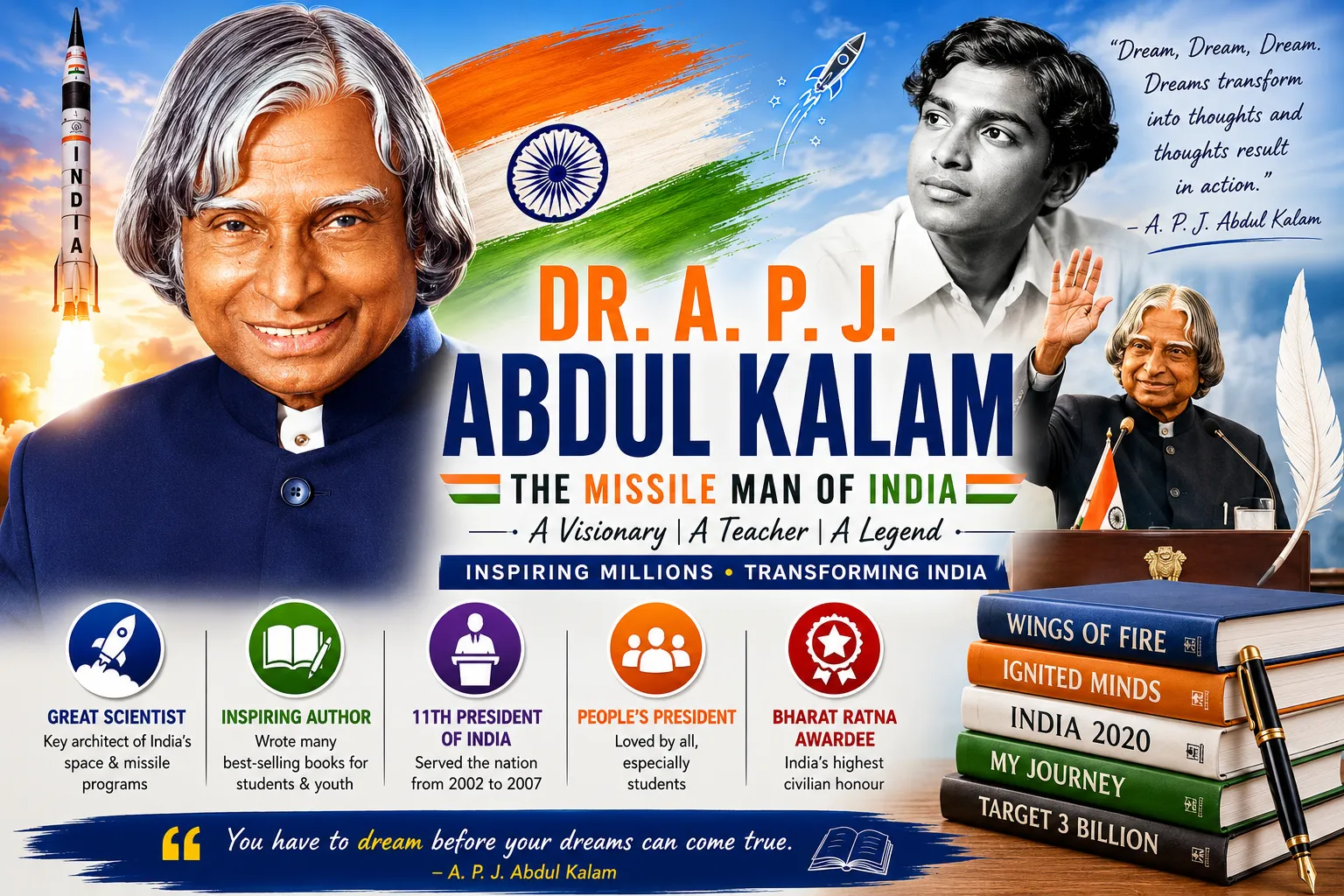
A. P. J. Abdul Kalam, popularly known as the “Missile Man of India”, was one of the country’s most respected scientists, teachers, authors, and visionaries. His remarkable journey from a humble childhood in the temple town of Rameswaram to becoming the 11th President of India is an inspiring example of dedication, hard work, and patriotism.
Throughout his life, Dr. Kalam inspired millions of students with his speeches, books, and motivational quotes. He played a crucial role in India’s missile and space programs and was awarded the country’s highest civilian honor, the Bharat Ratna. Even after leaving the Presidency, he continued to travel across India, motivating young people to dream big and contribute to the nation’s development.
APJ Abdul Kalam Quick Info
| Full Name | Avul Pakir Jainulabdeen Abdul Kalam |
|---|---|
| Popular Name | Dr. A. P. J. Abdul Kalam |
| Profession | Scientist, Author, Professor, Former President |
| Date of Birth | 15 October 1931 |
| Birthplace | Rameswaram |
| Nationality | Indian |
| Religion | Islam |
| Height | Approximately 5 feet 7 inches (170 cm) |
| Father | Jainulabdeen Marakayar |
| Mother | Ashiamma |
| Wife | Never Married |
| Death | 27 July 2015 |
| Age at Death | 83 Years |
| Famous As | Missile Man of India |
APJ Abdul Kalam Full Name
His full name was Avul Pakir Jainulabdeen Abdul Kalam. The initials “A. P. J.” stand for Avul Pakir Jainulabdeen, reflecting his family name and his father’s name.
Early Life of APJ Abdul Kalam
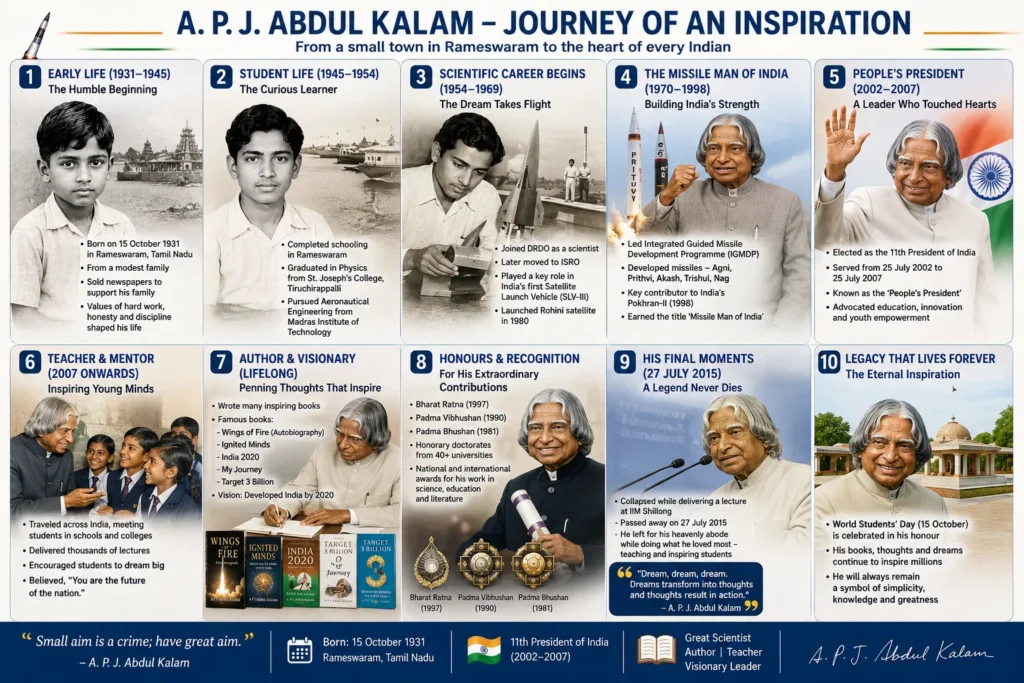
Dr. Kalam was born on 15 October 1931 in Rameswaram, Tamil Nadu. His family belonged to a modest background, and his father worked as a boat owner who ferried pilgrims between Rameswaram and Dhanushkodi.
Despite limited financial resources, his parents ensured that their children received a good education. From an early age, Kalam showed curiosity, discipline, and a strong desire to learn.
He often woke up before sunrise to study and help support his family. His humble upbringing taught him the values of honesty, hard work, and perseverance—qualities that remained with him throughout his life.
APJ Abdul Kalam Childhood
As a child, Kalam loved mathematics and science. He was known for his punctuality, discipline, and eagerness to learn. Although he came from a financially challenged family, he never allowed poverty to limit his dreams.
His teachers recognized his intelligence and encouraged him to pursue higher education. One of his science teachers, Sivasubramania Iyer, inspired him to dream of becoming an engineer and working with aircraft.
How Did Abdul Kalam Earn His First Wages?
During World War II, newspapers had to be distributed quickly because trains no longer stopped at Rameswaram station. Young Abdul Kalam helped his cousin distribute newspapers after bundles were thrown from moving trains. This was the first job of his life and the first time he earned money.
The experience taught him the importance of self-reliance and hard work at a very young age.
APJ Abdul Kalam Family
Dr. Kalam came from a close-knit and loving family.
Father
His father, Jainulabdeen Marakayar, was a boat owner and imam known for his wisdom, honesty, and simple lifestyle.
Mother
His mother, Ashiamma, was a caring homemaker who regularly fed poor people and travelers. Kalam often spoke about her kindness and generosity.
Brothers and Sisters
Dr. Kalam had several siblings and maintained a strong bond with his family throughout his life.
How Does Abdul Kalam Describe His Mother?
Dr. Kalam shared his love for his mother through his famous poem “My Mother.”
In the poem, he describes her as loving, compassionate, selfless, and spiritually strong. He credits her affection and guidance for shaping his personality and values. The poem remains popular among students and is often included in school literature.
Education of APJ Abdul Kalam
Education played a central role in Dr. Kalam’s success.
He completed his schooling in Rameswaram before studying Physics at St. Joseph’s College, Tiruchirappalli.
Later, he joined the Madras Institute of Technology, where he studied Aeronautical Engineering.
Although he initially struggled to pay his tuition fees, his family supported him, and he worked extremely hard to complete his education.
Dr. Kalam later said that education is the most powerful tool for transforming lives and encouraged students to develop scientific thinking.
APJ Abdul Kalam Images
APJ Abdul Kalam’s Career Begins
After graduating from the Madras Institute of Technology, Dr. Kalam joined the Defence Research and Development Organisation (DRDO) as a scientist.
Although he began his career working on small defense projects, he soon realized that his true passion lay in aerospace engineering and space technology.
In 1969, he moved to the Indian Space Research Organisation (ISRO), where he became the Project Director for India’s first indigenous Satellite Launch Vehicle (SLV-III).
Under his leadership, India successfully launched the Rohini Satellite into orbit in 1980. This achievement marked a historic milestone in India’s space program and established Dr. Kalam as one of the country’s leading scientists.
Why Is APJ Abdul Kalam Called the Missile Man of India?
During the 1980s and 1990s, Dr. Kalam led India’s Integrated Guided Missile Development Programme (IGMDP).
He played a key role in developing several indigenous missile systems, including:
- Prithvi
- Agni
- Akash
- Trishul
- Nag
Because of his outstanding contribution to India’s missile technology, he became popularly known as the “Missile Man of India.” His work significantly strengthened India’s defense capabilities and made him a national hero.
APJ Abdul Kalam as the President of India
In 2002, Dr. APJ Abdul Kalam was elected as the 11th President of India. He served from 25 July 2002 to 25 July 2007. During his presidency, he became one of the most loved Presidents in Indian history and was affectionately called the “People’s President.”
Unlike many political leaders, Dr. Kalam spent much of his time interacting with students, scientists, teachers, and young entrepreneurs. He believed that India’s future depended on its youth and encouraged students to dream big and work hard.
Throughout his five-year term, he promoted innovation, education, scientific research, and national development. Even after completing his presidency, he continued delivering lectures across India and remained deeply connected with young people.
APJ Abdul Kalam Awards and Achievements
Dr. Kalam received numerous national and international honors for his remarkable contributions to science, education, and public service.
Major Awards
- Padma Bhushan (1981)
- Padma Vibhushan (1990)
- Bharat Ratna (1997) – India’s highest civilian award.
- Honorary doctorates from more than 40 universities worldwide.
Major Achievements
- Led India’s first successful Satellite Launch Vehicle (SLV-III).
- Played a key role in developing the Agni and Prithvi missile systems.
- Contributed to India’s 1998 Pokhran-II nuclear tests.
- Served as the 11th President of India.
- Inspired millions of students through lectures and books.
- Promoted India’s vision of becoming a developed nation.
These achievements made him one of the most respected personalities in Indian history.
APJ Abdul Kalam Books
Dr. Kalam was not only a scientist but also a bestselling author. His books continue to inspire students, teachers, entrepreneurs, and leaders worldwide.
Famous Books Written by APJ Abdul Kalam
1. Wings of Fire
His autobiography, Wings of Fire, narrates his inspiring journey from a small town in Tamil Nadu to becoming India’s Missile Man.
2. Ignited Minds
A motivational book encouraging young Indians to develop confidence, creativity, and leadership.
3. India 2020
Co-authored with Y. S. Rajan, this book presents his vision of transforming India into a developed nation.
4. My Journey
A collection of personal experiences and life lessons.
5. Target 3 Billion
A book focusing on rural development and sustainable growth.
These books are highly recommended for students preparing for competitive exams and anyone interested in personal development.
APJ Abdul Kalam Quotes
Dr. Kalam’s words continue to inspire millions of people.
Famous APJ Abdul Kalam Quotes are :
“Dream, dream, dream. Dreams transform into thoughts and thoughts result in action.”
“If you want to shine like a sun, first burn like a sun.”
“Excellence is a continuous process and not an accident.”
“Small aim is a crime; have great aim.”
“Learning gives creativity, creativity leads to thinking, thinking provides knowledge, and knowledge makes you great.”
APJ Abdul Kalam Quotes on Education
Dr. Kalam believed education was the strongest weapon for national development.
Some of his educational thoughts include:
- Education builds confidence.
- Teachers shape the future of society.
- Knowledge should be combined with values.
- Every student has unique potential.
- Innovation begins with curiosity.
His educational philosophy continues to influence schools and universities across India.
APJ Abdul Kalam Thoughts for Students
Students were always close to Dr. Kalam’s heart.
He encouraged them to:
- Dream big.
- Never fear failure.
- Respect teachers.
- Develop scientific thinking.
- Work hard every day.
- Believe in themselves.
His speeches in schools and colleges inspired millions of young minds to pursue careers in science, engineering, medicine, and public service.
APJ Abdul Kalam World Students’ Day
The United Nations recognized Dr. Kalam’s dedication to young people by observing 15 October, his birthday, as World Students’ Day.
Every year, schools and colleges celebrate this day by organizing:
- Essay competitions
- Speech contests
- Science exhibitions
- Quiz competitions
- Motivational programs
The celebration honors his lifelong commitment to education and youth empowerment.
APJ Abdul Kalam Scholarship
Several scholarship programs across India have been named after Dr. Kalam to support talented students.
Popular scholarship initiatives generally focus on:
- Financial assistance for economically weaker students.
- Support for engineering, science, and technology education.
- Scholarships for meritorious students.
- Programs encouraging innovation and research.
APJ Abdul Kalam Religion
Dr. Kalam was born into a Muslim family and practiced Islam. At the same time, he deeply respected all religions and often emphasized India’s unity in diversity.
APJ Abdul Kalam Wife
Dr. APJ Abdul Kalam never married. He dedicated his entire life to science, education, research, and serving the nation.
He often described India’s youth as his extended family and devoted his time to inspiring future generations.
APJ Abdul Kalam House
Dr. Kalam was born in a modest ancestral home in Rameswaram, Tamil Nadu.
Today, the house has become a popular attraction for visitors interested in learning about his early life. It displays photographs, personal belongings, awards, and memories from his extraordinary journey.
Another important landmark is the Dr. A. P. J. Abdul Kalam National Memorial at Pei Karumbu near Rameswaram, where people pay tribute to the beloved leader.
APJ Abdul Kalam Cause of Death
On 27 July 2015, Dr. Kalam was delivering a lecture at the Indian Institute of Management (IIM) Shillong when he suddenly collapsed.
He suffered a cardiac arrest and was taken to a nearby hospital, where doctors declared him dead.
He passed away at the age of 83, doing what he loved most—teaching and inspiring students.
His death was mourned across India and around the world, with leaders and citizens paying tribute to his remarkable life and service.
APJ Abdul Kalam Legacy
Even years after his passing, Dr. Kalam remains one of India’s greatest role models.
His legacy continues through:
- Scientific achievements
- Inspirational books
- Educational initiatives
- Youth development programs
- Motivational speeches
- National awards and memorials
Millions of students still read Wings of Fire, quote his inspiring words, and celebrate his birthday as a reminder to dream big and work hard.
APJ Abdul Kalam Height
Dr. Kalam was approximately 5 feet 7 inches (170 cm) tall.
Although he maintained a simple lifestyle, his towering personality, humility, and wisdom made him one of the most respected leaders in India.
APJ Abdul Kalam Signature and Handwriting
Dr. Kalam’s signature and handwriting remain popular among students and collectors. His handwriting was neat, simple, and easy to read, reflecting his disciplined personality.
Today, his handwritten notes, letters, and signatures are displayed in museums, exhibitions, and educational institutions dedicated to his memory.
APJ Abdul Kalam Library and Memorial
Several schools, colleges, and public libraries across India have been named after Dr. Kalam to promote reading and scientific learning.
The Dr. A. P. J. Abdul Kalam National Memorial at Pei Karumbu, Rameswaram, was inaugurated in 2017. The memorial showcases:
- Personal belongings
- Awards and medals
- Books and manuscripts
- Photographs from different stages of his life
- Models of missiles and rockets
Thousands of visitors, students, and tourists visit the memorial every year to pay tribute to the “People’s President.”
Interesting Facts About APJ Abdul Kalam
Here are some fascinating facts about Dr. Kalam:
- He was born on 15 October 1931 in Rameswaram, Tamil Nadu.
- His full name was Avul Pakir Jainulabdeen Abdul Kalam.
- He sold newspapers as a child to support his family.
- He was instrumental in developing India’s missile program.
- He became the 11th President of India in 2002.
- He received the Bharat Ratna in 1997.
- He authored several bestselling books, including Wings of Fire.
- He never married and dedicated his life to the nation.
- He loved interacting with students and delivered thousands of motivational speeches.
- He passed away while addressing students at IIM Shillong on 27 July 2015.
Frequently Asked Questions (FAQs)
Q1. What is APJ Abdul Kalam’s full name?
His full name was Avul Pakir Jainulabdeen Abdul Kalam.
Q2. Why is APJ Abdul Kalam called the Missile Man of India?
He earned this title for leading India’s Integrated Guided Missile Development Programme (IGMDP) and contributing to the development of missiles such as Agni and Prithvi.
Q3. When was APJ Abdul Kalam born?
He was born on 15 October 1931.
Q3. Where was APJ Abdul Kalam born?
He was born in Rameswaram, Tamil Nadu, India.
Q4. Who were APJ Abdul Kalam’s parents?
His father was Jainulabdeen Marakayar, and his mother was Ashiamma.
Q5. Was APJ Abdul Kalam married?
No, Dr. Kalam never married.
Q6. Which books were written by APJ Abdul Kalam?
Some of his famous books include:
Wings of Fire
Ignited Minds
India 2020
My Journey
Target 3 Billion
Q7. What was APJ Abdul Kalam’s religion?
He was born into a Muslim family and respected all religions throughout his life.
Q8. What awards did APJ Abdul Kalam receive?
1. Padma Bhushan
2. Padma Vibhushan
3. Bharat Ratna
Q9. When did APJ Abdul Kalam become President?
He became the 11th President of India on 25 July 2002.
Q10. What was APJ Abdul Kalam’s height?
His height was approximately 5 feet 7 inches (170 cm).
Q11. How did APJ Abdul Kalam die?
He suffered a cardiac arrest while delivering a lecture at IIM Shillong on 27 July 2015
Q12. What is World Students’ Day?
15 October, Dr. Kalam’s birthday, is observed as World Students’ Day in recognition of his dedication to education and students.
Conclusion
Dr. APJ Abdul Kalam’s life is a timeless example of determination, humility, and service to the nation. Rising from modest beginnings in Rameswaram, he became one of India’s greatest scientists, earned the title of the Missile Man of India, and later served as the 11th President of India. His scientific achievements strengthened India’s defense and space capabilities, while his books and speeches inspired generations of students.
Even today, his vision of a developed India, his emphasis on education, and his message to “dream big” continue to motivate millions. His legacy lives on through his writings, memorials, scholarships, and the countless young minds he inspired. Dr. APJ Abdul Kalam will always be remembered as a true patriot, visionary leader, and one of the greatest role models in Indian history. for more biography like this you can contact us or comment us.